
Our market research found that packaging is no longer just a single image — today, half of packaging design is about "content"
A tea beverage client of ours sells tea bags and came to us for packaging. Their opening request: make it younger, the kind you can photograph. I said, "the kind you can photograph" — that requirement, its
A tea beverage client came to me for packaging. Their product is tea bags. The first thing they said was: “Make it young, the kind people want to photograph.”
I said the “photograph” requirement is actually much higher than “good-looking.”
He didn’t get it: isn’t photographable just the same as good-looking?
I said no, it’s different. Good-looking means you think it looks good; photographable means other people are willing to shoot it — and if they’re willing to shoot it, that means the packaging can be sent out as “content,” and customers will promote you for free.
These days, everyone scrolls their phones all day and is long desensitized to ads. You spend a hundred thousand on feed ads and people swipe past in a second; but if you get customers to take a photo themselves and post it to their Moments, that beats any ad. So packaging today is half making a container and half making “content” — content that customers are willing to show off.
The tea bag category is especially suited to making content. Because it’s light, small, and everyday — young people buy it and leave it on the desk or the office table, seeing it every day. If the packaging is interesting, then one afternoon, with the sunlight just right, they’ll brew a cup and casually snap a photo — and your brand rides along into their Moments.
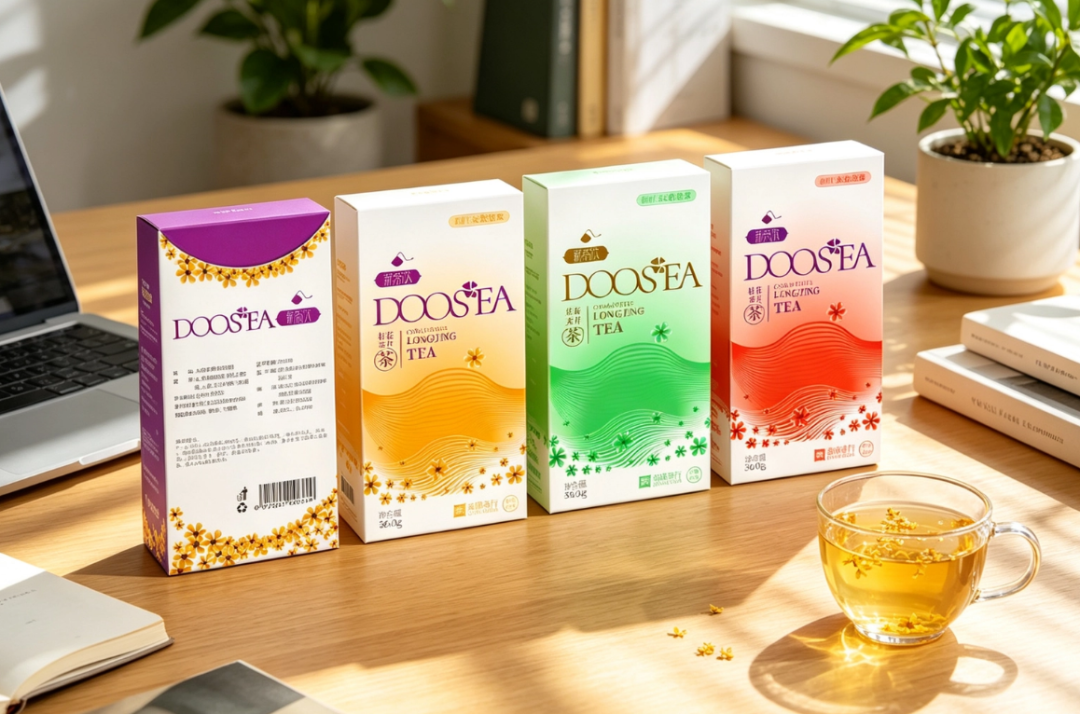
— Square paper box desk scene display
Here’s the solution we ultimately delivered: a square paper box in matte white card, with one color family per tea variety — the lid edged in a contrasting color, like the purple lid on the osmanthus Longjing; the body printed all over with a background-pattern illustration, and a single campanula hot-stamped in gold on the front — hit it with light and the flower glows. Line up all three teas and the gradient background patterns run in a row, like three books.
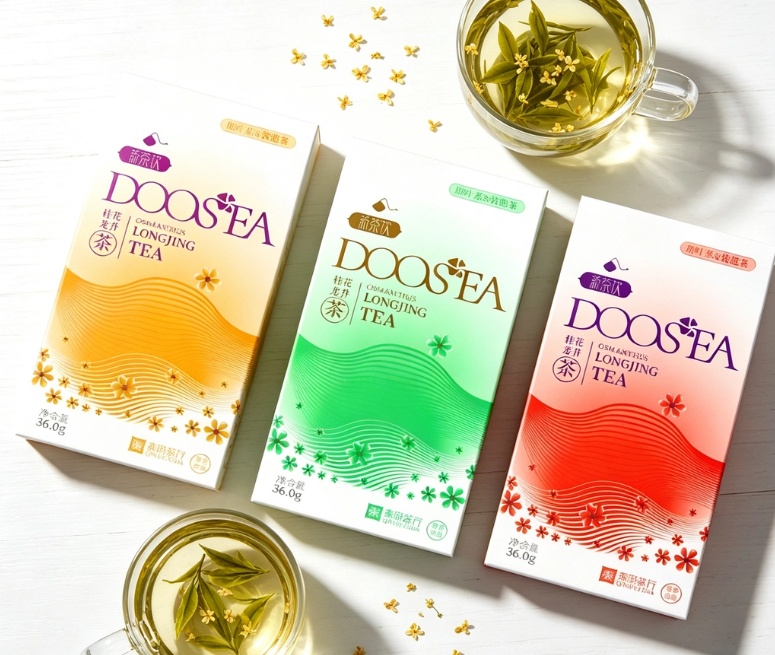
— Top-down shot of three color-family paper boxes with gold-stamped campanula illustrations
We really sweated the gold-stamping detail. The client thought hot-stamping was expensive and wanted to cut it. I said if you save the money on this flower, then when customers take photos there’s no “finishing touch” highlight. Later, when the prototype came out, he held the box up to the window and said the flower really does lift it — the whole box’s classiness rests on that one touch.
For the gift box we made a purple rigid box with a lift-off lid; open it and there are three individual tea boxes, held neat and square in a light-brown corrugated inner tray, with a pinch of real dried osmanthus as an accent. The client said this one is for gifting, so the moment of opening has to deliver a surprise.
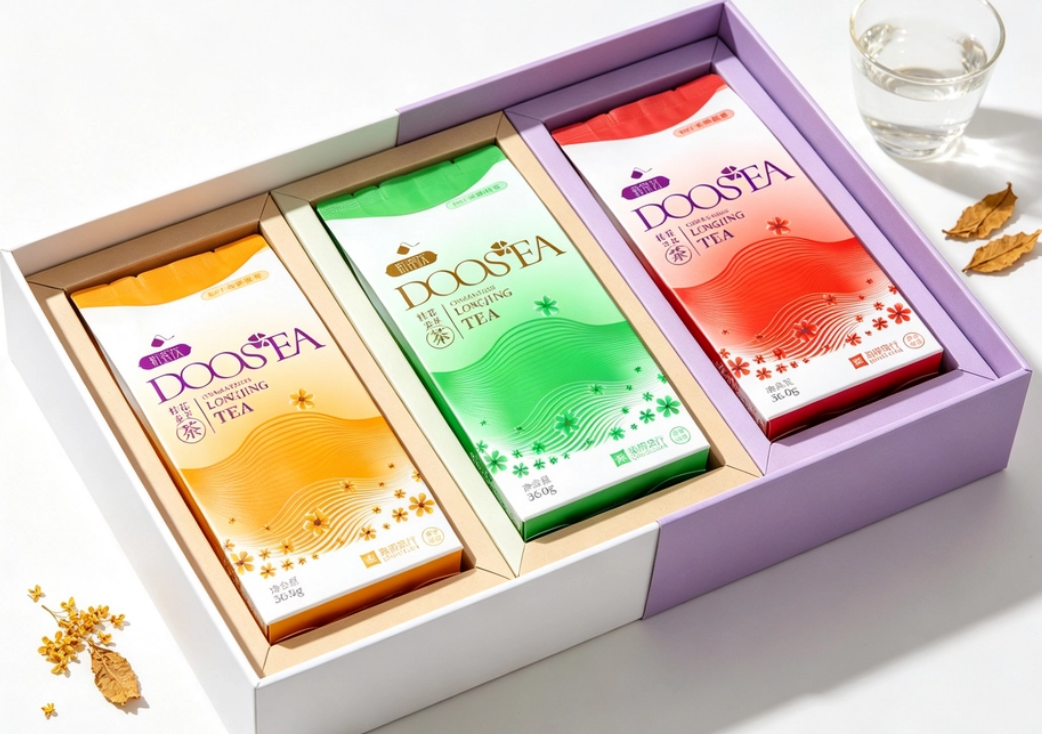
— Purple gift box opened with dried osmanthus inner tray
The client asked: why does each box need its own color family? I said think about it — when a customer opens a box of tea, three flavors in three colors, won’t they want to shoot a nine-grid? Won’t they post it in a group chat asking “which color do you guys think looks best?” That’s what it means to let the product generate its own buzz.
And then something fun actually happened: a girl posted a “one-week tea bag check-in” series on social media — seven days straight, brewing one variety a day, each with a line about her mood. That post got over ten thousand likes, and the comments were full of people asking “where do I buy this?”
I said, see — this is “content co-creation.” I didn’t have you spend a cent hiring influencers; the customers became your recommenders themselves.
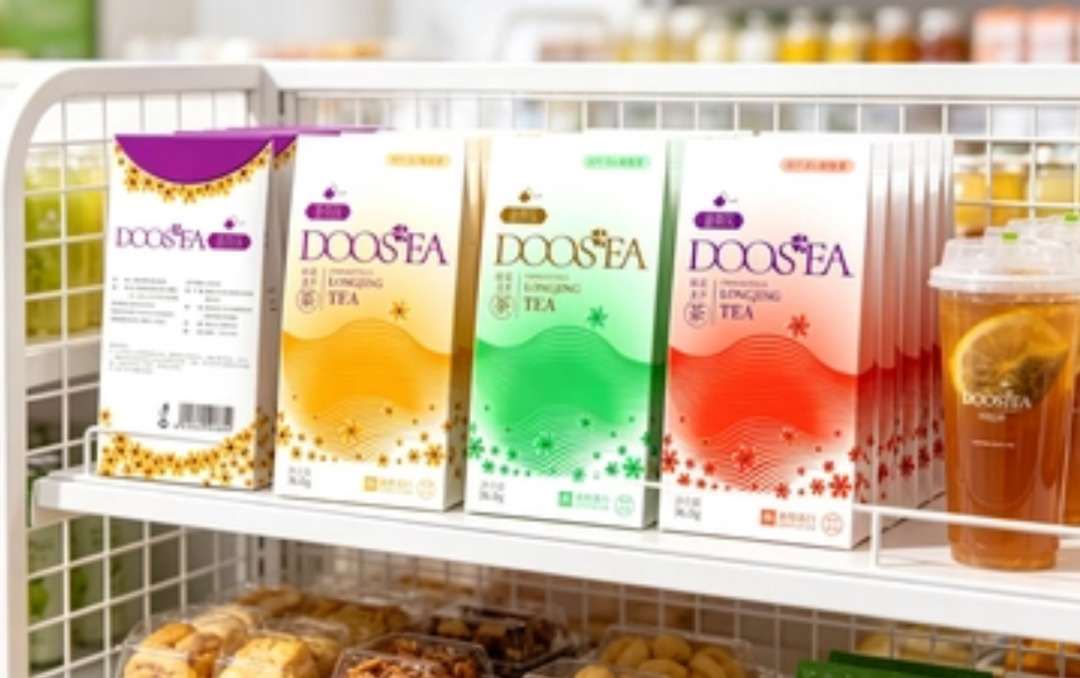
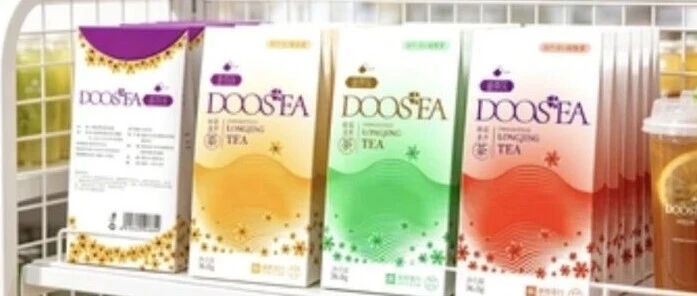
— Convenience store shelf display, real shot
This taught me a lot: in the past, when we did packaging, we studied how to print the information clearly; now, when we do packaging, we have to think one layer deeper — once customers have it in hand, are they willing to “talk” it up? All those illustrations, color schemes, and little details on the packaging are handing customers a conversation starter.
Of course, the premise is still that the product delivers. Packaging makes people shoot; the product makes people stay. If your tea isn’t good, they’ll shoot it once and never again; if the tea is good, this packaging can sell for you for years.
Sanyao Packaging
Good packaging speaks.
About This Case: Quick Answers
Are finishing processes on packaging (foil stamping, matte coating, etc.) worth it?
Spending a few dimes to a dollar more per bottle buys you a texture that catches the eye under the counter lights and the gut feeling that "this bottle isn't cheap." Finishing isn't showing off technique—it's money spent to make consumers willing to believe it's worth the price, and that dollar comes back doubled in the selling price.
Can the product approach in this article work for my product too?
Yes. This logic isn't picky about category—as long as your product sits on the shelf looking like everyone else's and consumers can't recognize you in three seconds, it works. When it comes to execution, we'll set a new plan based on your category, channel, and price band rather than forcing someone else's face onto yours.
If I hire you for product packaging, how do you usually charge, and how long does it take?
We charge per project, depending on category complexity, the number of series, and whether prototyping and extensions are included. Typically 2–4 weeks: the first week sets direction and positioning, the second week delivers concepts, and the third and fourth weeks deepen, prototype, and finalize. Rush jobs can be compressed, but we recommend leaving time for physical prototyping. Send us your materials for a free diagnosis first, then we'll quote.
We're in another city—can we collaborate online?
Yes. Many of our projects are remote collaborations: materials coordinated online, concepts reviewed in the cloud, prototypes shipped by courier—no geographic limits, and we work with clients nationwide.

CommentsBe kind, communicate rationally