
Do you still believe ad slogans that brainwash you three times over? The old marketing model is completely gone—the way traffic works has completely changed
Sanyao: Don't applaud yourself—design the applause into the details, and let customers set it off for you.
,Traffic YISANYAO · Strategy & Design
Sanyao Strategy & Design
Packaging determines price perception · Your product deserves to be seen properly

Fellow business owners, have you ever had this experience: the whole family is gathered around the TV at night, really into the show, and suddenly a commercial cuts in, playing the same slogan three times in a row, loud enough to give you a headache. Back then, traffic was concentrated, ads were forced on you, and brainwashing was treated as “science.” But today, if you take the same trick to mobile, users just swipe away with a flick of the finger—and they’re annoyed you’re so loud.
“
This article is about 1,100 words, roughly a three-minute read. Today we’re not talking news—we’re talking about a pitfall business owners fall into every day: why the more you say you’re good, the more customers are annoyed; why “don’t boast, nail the details, and let customers spread the word for you” is the most reliable marketing right now. Three of our own real cases, laid out for you to see.
A couple of days ago I had dinner with a long-time client. He suddenly sighed: you know, that so-called master from before—he’d toss off a single ad line for a tea drink and charge five million and up. How does it sound more and more like a joke now?
I said, yeah. That playbook lived off the dividends of the TV era. The family sits around the table eating, the TV is on, the ad comes and you can’t dodge it, a line like “this holiday, no gifts but this” loops three times, and you remember it whether you want to or not. Back then traffic was concentrated, attention was concentrated, and one slogan could conquer the world—that wasn’t an exaggeration.
But now? Now it’s short, fast, interactive, emotional. Users hold their phones, their attention shattered into pieces, and if you still want to drive a nail into their heads with a slogan, it just won’t go in. Worse, the more you shout “I’m the best” “I’m number one,” the more people think you’re bragging—emotion is like that: the moment you boast, it backfires.
I’ve done packaging design for many years, and I believe one thing more and more: marketing today isn’t “I talk, you listen”—it’s emotion. Emotional value is the most precious thing in this era. Rather than praising yourself to the skies, let customers “feel it” for themselves. Good things speak for themselves—provided you give them a mouth that can speak.
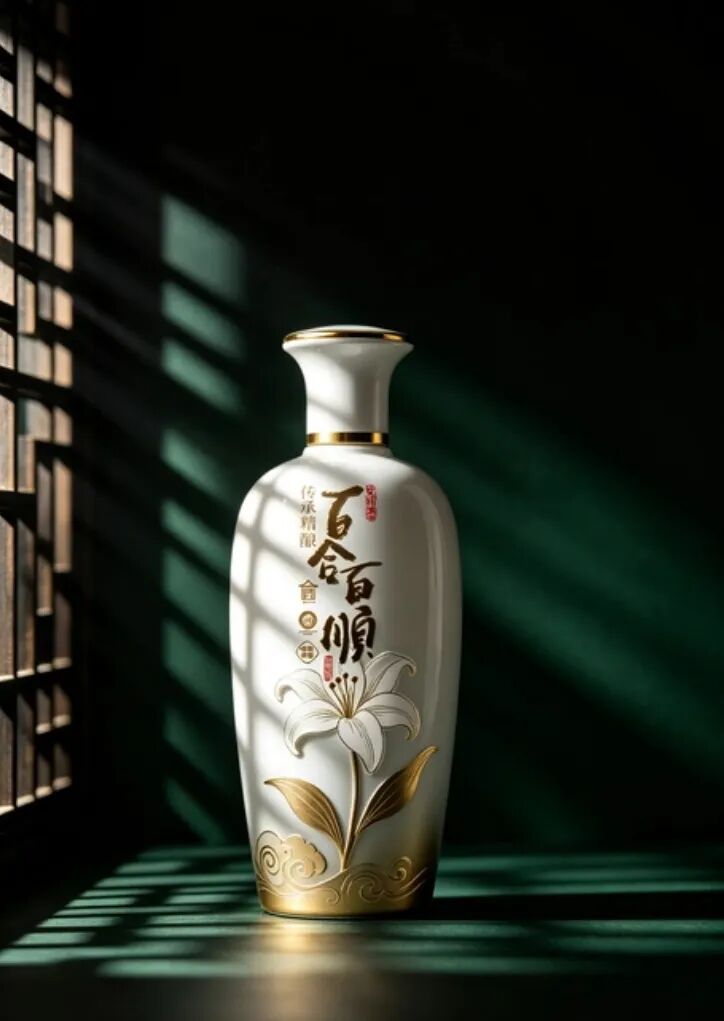
Baihe Baishun matte white porcelain bottle
Here’s a real story of our own. Last year we did “Baihe Baishun,” a bottle of baijiu. At first the client also wanted that red-and-gold festive look, with “premium” written all over it. I said no. The baijiu shelf has no shortage of red; everyone shouts that they’re good, and if you shout too, you drown. So we went the other way: a matte white porcelain bottle, white lily petals with gold leaves, a ring of auspicious cloud patterns at the base; the box is a cream-white rigid box with almost no text on the front. Not a single “how great I am” the whole way through.
And the reason is very practical: this bottle doesn’t steal the spotlight on a wedding table, and it photographs as high-end. See—we didn’t praise it once; it was that touch of matte white and that ring of auspicious clouds that delivered the word “dignified” into people’s hearts for us. Nail the details, and customers will be moved on their own—you don’t need to shout at all.
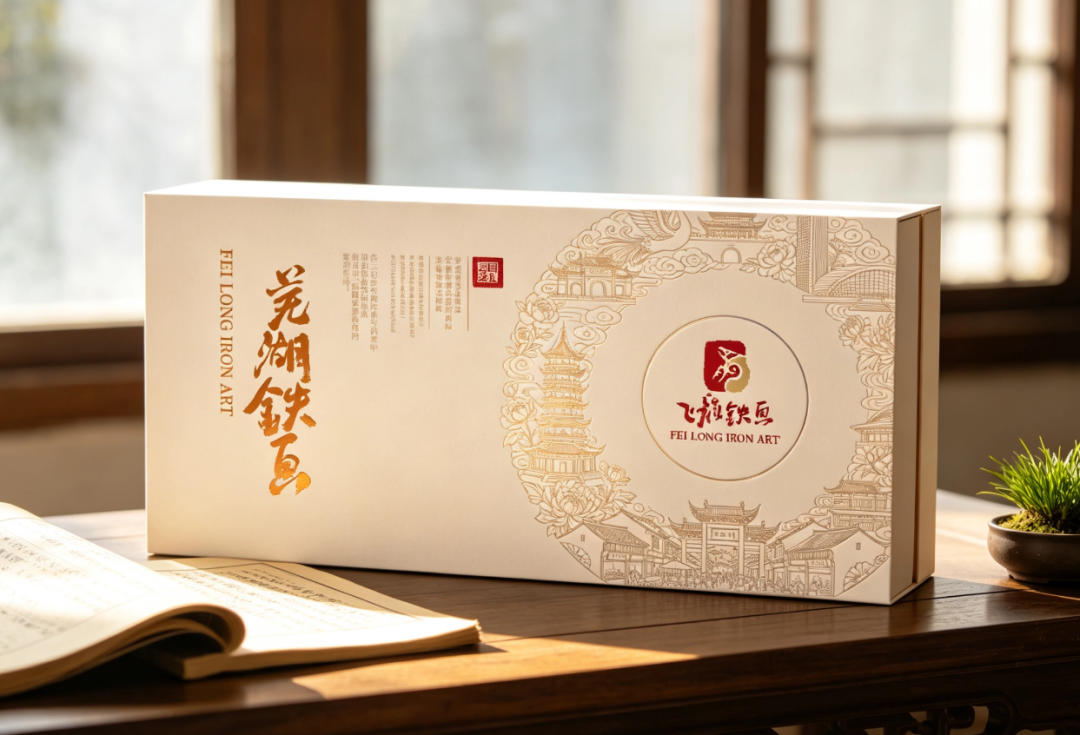
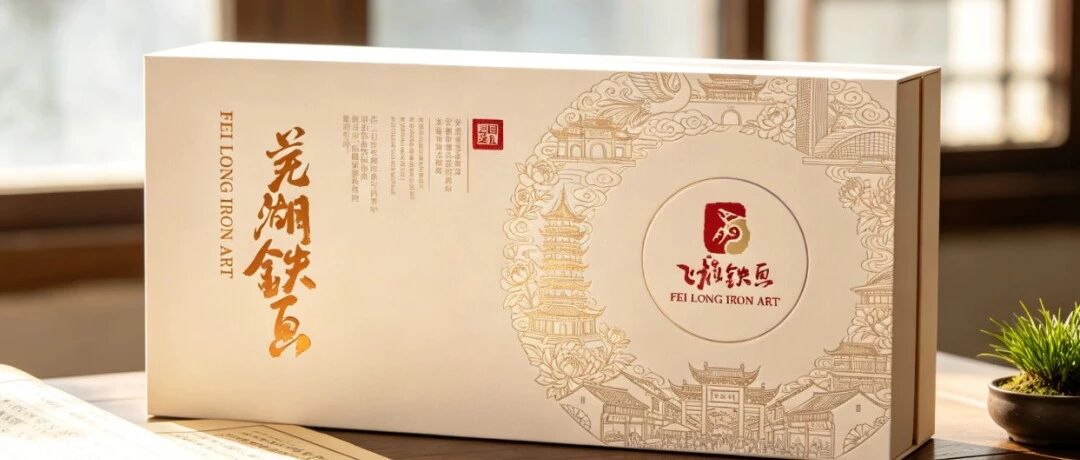
Feilong iron painting gift box front key visual
Now look at this Feilong iron painting gift box set. Iron painting itself is black and heavy, yet we set it against a cream-white base, with the four characters “芜湖铁画” (Wuhu iron painting) in gold-stamped calligraphy on the front; open the box and the work is set into a velvet-lined recess—layered, luminous. We never posted a single WeChat Moments update saying “come buy intangible cultural heritage.” But when people receive it and open the box, they go “wow” and snap a photo and post it. One person posts, their friends see it, and they learn that Wuhu iron painting can be given as a dignified gift—that’s more effective than ten thousand boasts from us.
This is what I call “gentle all-platform communication.” It’s not you holding a megaphone and shouting to the whole world; it’s you planting hooks in the details so customers willingly spread the word for you. The fuel of communication is emotion, not volume.
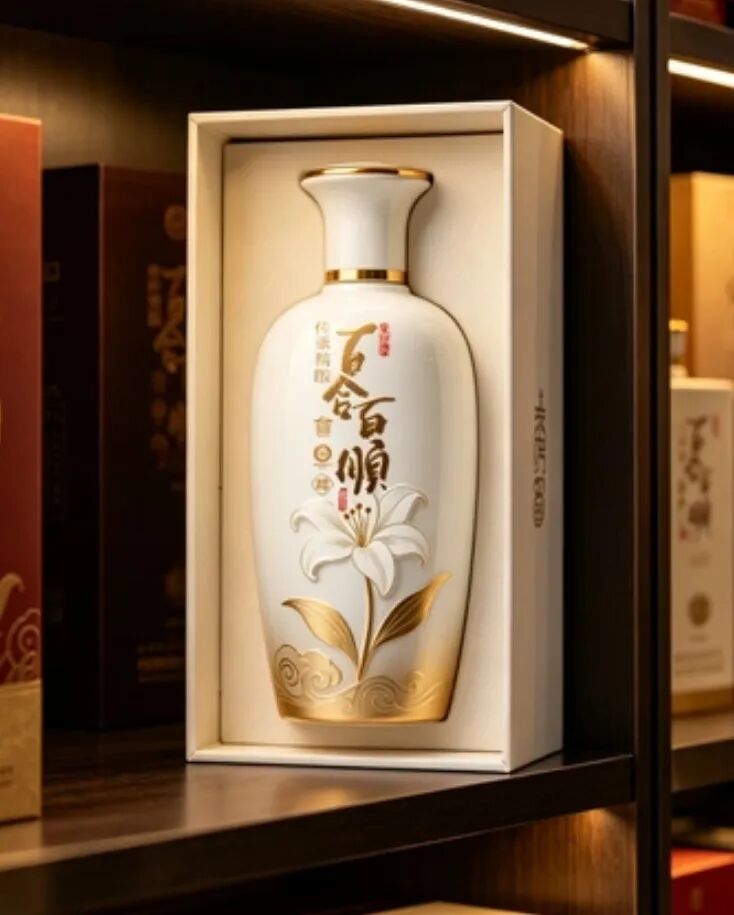
Baihe Baishun liquor cabinet display effect
Think about it the other way: why does that five-million ad line keep losing favor? Because people today have been fed too much on tricks. CCTV exposed livestream rooms where twenty of twenty-seven “tea farmers” were actors; in private domains, ordinary tea cakes get packaged as “century-old ancient trees,” and once sold, the account is deregistered and reborn under a new shell. Boasting, fabricating, shouting slogans—users’ first reaction now is: really? Don’t fool me. The more you boast, the more guarded they get, and the emotion backfires straight into distrust.
So, fellow business owners, come back to your own product. Stop racking your brain over “how to write a killer ad line,” and think more about this: does my packaging quietly and gracefully deliver the real value into the customer’s hands for me?
One line to close: in this era, don’t applaud yourself—design the applause into the details, and let customers make it ring for you.
This article’s text and images are presented solely as creative case studies by Sanyao Strategy & Design; the brands and products mentioned belong to their respective clients.
Sanyao Strategy & Design
Years of packaging design · Wuhu, Anhui
Packaging determines price perception—your product deserves to be seen properly
About This Case: Quick Answers
How does a product actually get "seen" on the shelf?
Consumers give you only three seconds in front of the shelf. The most reliable approach is to design on two levels: from three meters away, grab attention with color and shape; from one meter in, stop people with information and cultural trust signals. The root cause of most products that don't sell isn't that they're bad — it's that the "good" never manages to shout from three meters away.
Can my product use this same baijiu playbook?
Yes. This logic doesn't discriminate by category — as long as your product sits on the shelf looking like everyone else's and consumers can't recognize you in three seconds, it works. When it comes to execution, we'll build a fresh plan around your category, channel, and price tier rather than forcing someone else's face onto yours.
What do you typically charge for product packaging, and how long does it take?
We price per project, based on category complexity, number of SKUs in the series, and whether prototyping and extensions are included. Typically 2–4 weeks: week one sets direction and positioning, week two delivers concepts, and weeks three and four refine, prototype, and finalize. Rush timelines can be compressed, but we recommend leaving time for physical prototyping. Send us your materials for a free diagnosis first, then we'll quote.
We're based elsewhere — can we work together online?
Absolutely. Many of our projects are remote collaborations: materials shared online, concepts reviewed in the cloud, prototypes shipped by courier. There are no geographic limits — we work with clients nationwide.
CommentsBe kind, communicate rationally