
Why Is It Harder for E-commerce Sellers Who Are Great at Selling to Build a Brand?
The five barriers that keep e-commerce sellers from building a brand, plus three self-check questions to judge whether your packaging is helping the brand or just acting as a shipping box.
”
Reading note: This article is about 1,100 words, roughly a 4-minute read. Today we mainly break down the “five barriers” that keep e-commerce sellers from building a brand, and offer three practical self-check questions—to help you judge whether your packaging is actually helping the brand, or just acting as a shipping box.
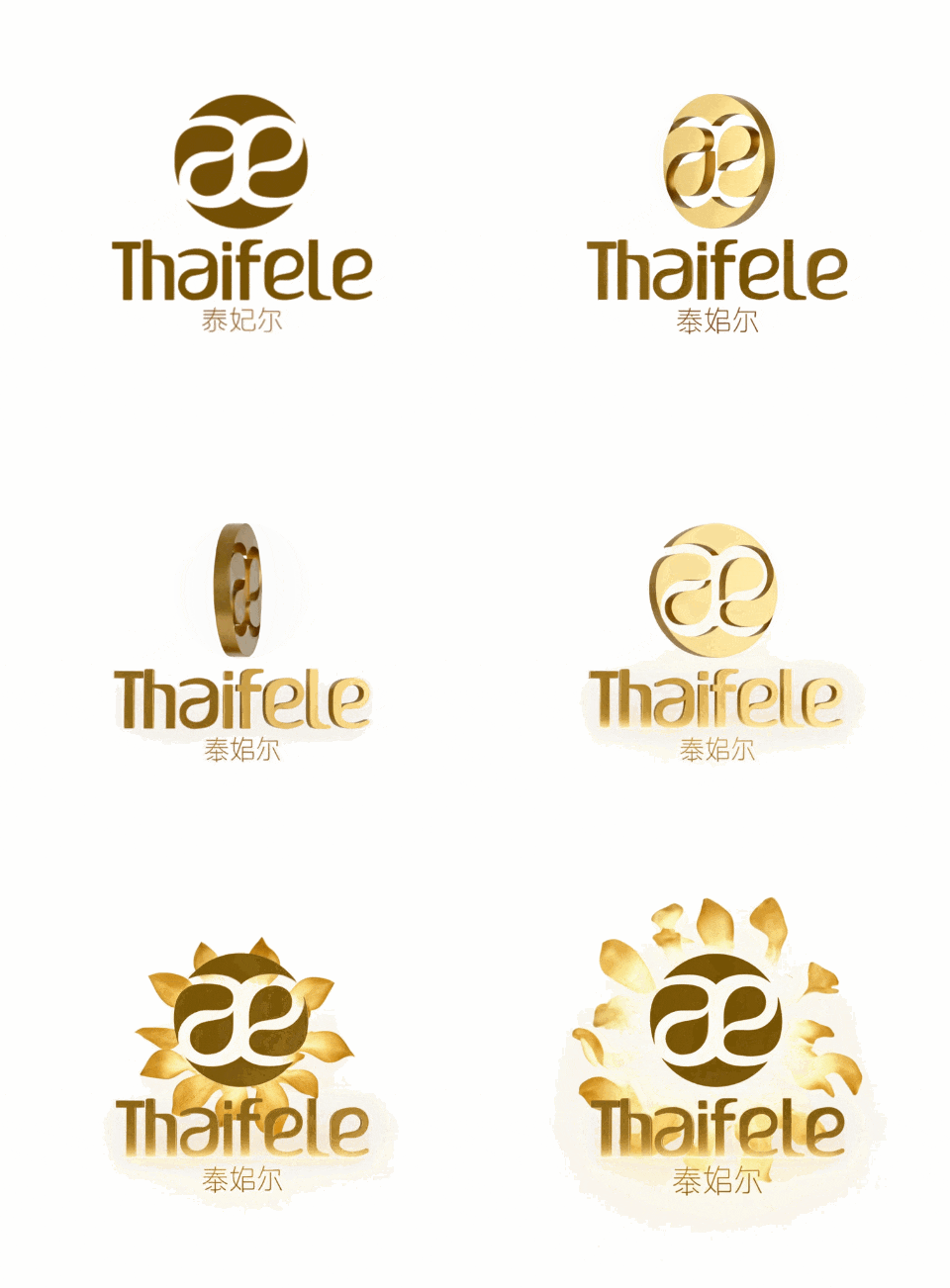
I’ve met a lot of e-commerce owners, and their goods are genuinely good.
Some ship from their own factories, with quality control stricter than the big brands; some travel across growing regions hunting for raw materials, just for that more authentic taste. To be honest, the “good products” hidden among these people are no fewer than the big-name brands on the shelves.
But the line I hear them sigh most is: “The stuff isn’t bad, it just won’t sell at a premium—let alone become a brand.”
Where’s the problem? Most owners pour all their energy into “making the goods well and targeting the traffic right,” but they have neither the energy nor the right professional people to dig out “what exactly makes this product good” and translate it into words customers understand at a glance. The packaging is dry, the detail page copies competitors, and the brand naturally can’t stand up. Good things get held back by “not knowing how to say it.”
In eight years of doing e-commerce, I’ve watched hundreds of brands go from taking off to flaming out. Stripped down, the root causes come down to these few.
”
The platform’s algorithm rewards “buy now,” while a brand’s business relies on “remember you.” These two things are fundamentally opposed.
Traffic logic and brand logic are inherently at odds
What the platform wants is conversion rate and average order value, so the algorithm gives traffic to stores that are “cheap and convert well.” The owner looks at ROI and can only cut prices, buy paid search ads, and chase sales volume. When you do the math, the margin is thin as paper—where’s the budget for branding?
So the result is: the more you sell, the cheaper it gets; the cheaper it gets, the more you have to sell; and the branding budget is always pushed to “tomorrow.”
The shelf shrinks to a single big image
In an offline supermarket, customers can pick it up and weigh it, see the reflection on the bottle, feel that “valuable” texture. What about e-commerce? When a customer swipes to your listing, what they see is a palm-sized image on a phone, with the price hanging below.
Whatever “premium feel” and “trust” the packaging has gets crushed in that small image. The foil stamping and bottle shape you put your heart into—the customer swipes past in 0.3 seconds and never catches it.
White-label supply chains erase the differences
Many e-commerce sellers get the same batch of source goods, swap the detail page, change the title, and list it. The product itself has no differentiation, and the packaging is copied back and forth—so why should customers remember you? If they can’t remember you, there’s no brand to speak of.
The customers are in the platform’s hands, not yours
E-commerce repurchases rely on “buying traffic again” to pull them back, not on them “recognizing your brand.” You only have orders, not users. The day you stop paying, the traffic cuts off immediately. That’s called renting traffic, not building a brand.
Packaging lives on as a shipping box
To withstand pressure and save on postage, e-commerce packaging becomes a mailer box plus bubble wrap. The customer opens it—no surprise, no memorable point—and the box goes straight into the trash. Those three seconds of unboxing are the golden moment for building a brand impression, and they’re wasted just like that.
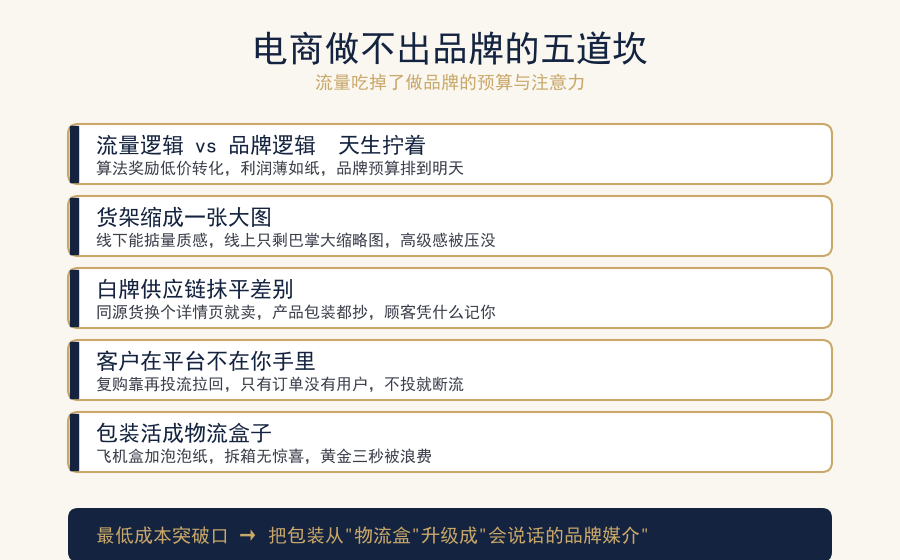
The five barriers that keep e-commerce sellers from building a brand
By now you probably get it: e-commerce sellers failing to build a brand isn’t entirely the owner’s fault—it’s this whole playbook eating up all the budget and attention for “building a brand.”
But there’s one place that’s the lowest-cost, highest-upside breakthrough for e-commerce—.
Online competition has already turned into a red ocean, but “the moment of unboxing” is still a blue ocean. Upgrade packaging from “a box that holds goods” into “a brand medium that speaks”:
Let customers feel surprise when they open the box, and remember you;
Let the product convey its quality even in a small image;
Print “what’s good about it” right on the packaging, without you having to explain it painstakingly.
These three things, in the end, can be summed up in one sentence:
”
Customers won’t remember your paid search ads, but they’ll remember the box that made them want to snap a photo and post it to Moments.
I’ve seen too many examples: the same box of goods, once the packaging is upgraded, doesn’t even need major changes to the detail page—conversions go up and repurchases follow. A brand isn’t built by burning money; it starts with the single act of making customers “remember you.”
Three-question self-check: Is your packaging helping the brand?
If you’re an e-commerce owner with good goods and you know how to buy traffic, but the brand just won’t take off—don’t rush to pour more into ads. First look back at your packaging and ask whether it’s honestly just being a shipping box.
Check yourself against these three questions:
No, that means no memorable point.
Can’t tell, that means you’re losing out online.
Can’t explain it clearly, that means a good product is still “staying quiet.”
If you can’t hit two of the three, then the brand is still stuck at the “selling goods” stage.
Get this packaging step right, and e-commerce can grow its own brand too. Many owners don’t have bad goods—they just haven’t put on that “skin that speaks”—and that skin is precisely the closest and cheapest brand entry point to the customer.
Sanyao Planning & Design
8 years of packaging strategy · Wuhu, Anhui
Packaging determines perceived pricing—your product deserves to be seen properly
Need a packaging upgrade? Follow us and tap “Contact Sanyao” in the menu bar, or leave a message “packaging” in the backend to get the diagnostic key points for free.
About This Case: Quick Answers
How exactly does a product get "seen" on the shelf?
Consumers give you only three seconds in front of the shelf. The most reliable approach is to design in two layers: at three meters, grab attention with color and shape; within one meter, stop people with information and cultural trust signals. The root cause of most products not selling isn't that they're bad—it's that the "good" never gets shouted out from three meters away.
Can my product use this "renting traffic" playbook too?
Yes. This logic isn't picky about category—as long as your product looks pretty much like everyone else's on the shelf and consumers can't recognize you in three seconds, it applies. When it comes to execution, we'll redefine the plan based on your category, channel, and price band, rather than forcing someone else's face onto yours.
If I hire you for product packaging, how do you usually charge, and how long does it take?
We charge per project, depending on category complexity, the number of series, and whether it includes prototyping and extensions. Typically 2–4 weeks: the first week sets direction and positioning, the second week delivers concepts, and the third and fourth weeks deepen, prototype, and finalize. Rush jobs can be compressed, but we recommend leaving time for physical prototypes. Send us your materials for a free diagnosis first, then we'll quote.
We're in another city—can we collaborate online?
Yes. Many of our projects are remote collaborations: materials coordinated online, concepts reviewed in the cloud, and prototypes shipped by courier—no geographic limits, and we work with clients nationwide.



CommentsBe kind, communicate rationally